cd ..
EN
Networking
Beyond the Graphs: Why a Monitoring System is the Invisible Pillar of Your Business (and Your Peace of Mind)
R
Rodolfo Echenique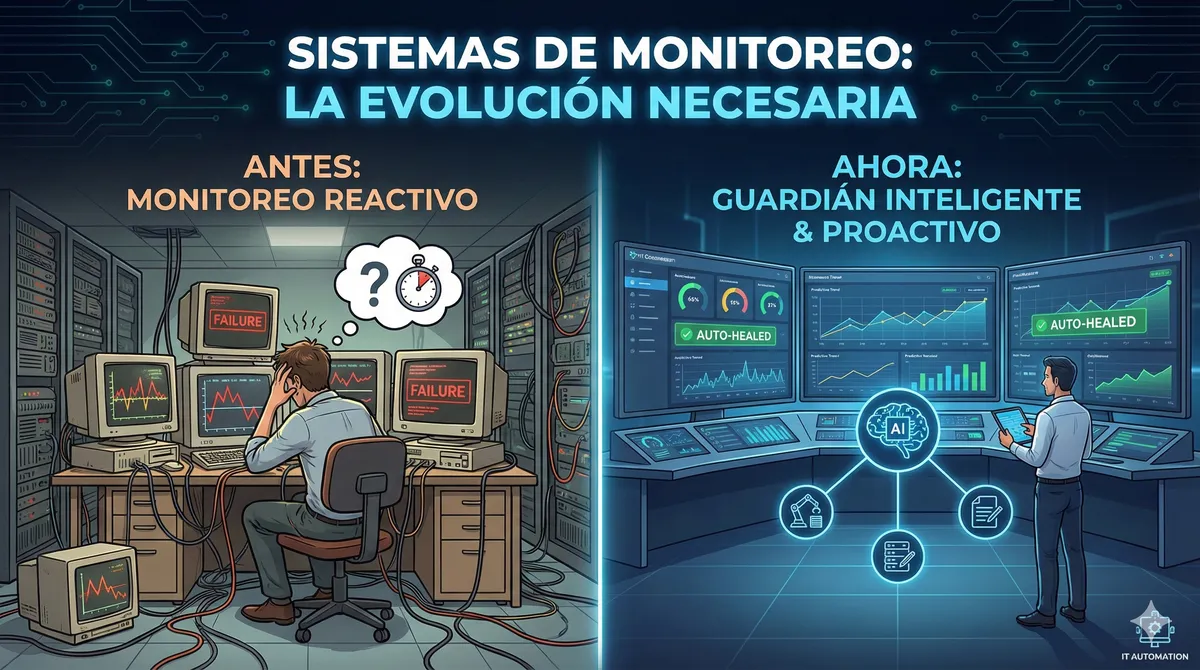
Automated Translation: This article was originally written in Spanish and translated by Gemini AI.
In the fast-paced world of technology, where every millisecond of downtime can cost millions, one question becomes vitally important: What exactly is a monitoring system and why is it indispensable?
For leaders and executives, the formal definition from ECLAC – "management instruments responsible for providing information on performance to feed better decision-making and generate improvements in interventions" – is a valid starting point. But for those of us in the technology trenches, for the IT team that lives and breathes daily operations, we see it differently.
Personally, I define a monitoring system as the passive and proactive IT support that allows us to have a clear view of our systems, alert us to anomalies, and, crucially, analyze and resolve concrete problems before they escalate into crises.
From Static Screens to Intelligent Guardians: The Evolution of Monitoring
Do you remember the old days? Screens full of timelines and histogram graphs, where values rose and fell frantically. To understand whether a system was healthy or on the verge of collapse, we relied on "gurus" who interpreted those fluctuations. It was reactive, tedious, and prone to human error.
Today, although those historical graphs are still valuable, monitoring systems have transcended that phase. With the exponential growth of Tech industries, IT teams face a constant challenge: predicting and preventing failures that can paralyze an entire business. But there is an inescapable reality: IT teams are not always present 24/7 in the office. Globalization, remote work, and business decisions have created an urgent need for tools that extend vigilance beyond working hours.
The Power of Automation: Monitoring that Acts, Not Just Displays
This is where the evolution of monitoring becomes a true marvel of engineering and automation. A modern monitoring system no longer just "draws" graphs on a screen; it is now capable of:
- Proactively Alert: Send instant notifications (messages, emails, calls) when it detects an anomaly, even before it causes an impact.
- Execute Corrective Actions: From running a script to restart a critical service to automatically balancing the load to prevent a major failure. It can even solve problems by itself!
- Offer Complete Traceability: Generate detailed traceability graphs and logs that allow the IT team to analyze the root cause of an incident, identifying whether the problem lies in their infrastructure or a third-party service (such as an ISP).
This does not mean that IT staff are replaceable. Absolutely not. Monitoring systems are an additional vital support, an extension of human capacity, not a substitute.
The IT Pro’s Peace of Mind: Rest with Awareness
When a monitoring system is properly configured, IT teams can enjoy unprecedented peace of mind. Upon arriving at the office the next day, instead of putting out unexpected fires, they can focus on:
- Reviewing historical data and logs to understand what happened overnight.
- Analyzing the problems that the system automatically resolved.
- Dedicating their time and talent to more strategic and higher-value business tasks.
I have no doubt: in the vast majority of cases, the implementation and optimization of a monitoring system drastically mitigates the problems that constantly plague IT teams.
Today, there are countless monitoring solutions, from open-source tools to robust enterprise platforms. The key is for each IT team to evaluate their specific needs and decide how to integrate these powerful tools to transform their operation. The question is no longer whether they are necessary, but how efficiently we are utilizing them.