cd ..
EN
Networking
The Network Dilemma: When Is an L3 Switch Enough and When Do You Need the Intelligence of a Router?
R
Rodolfo Echenique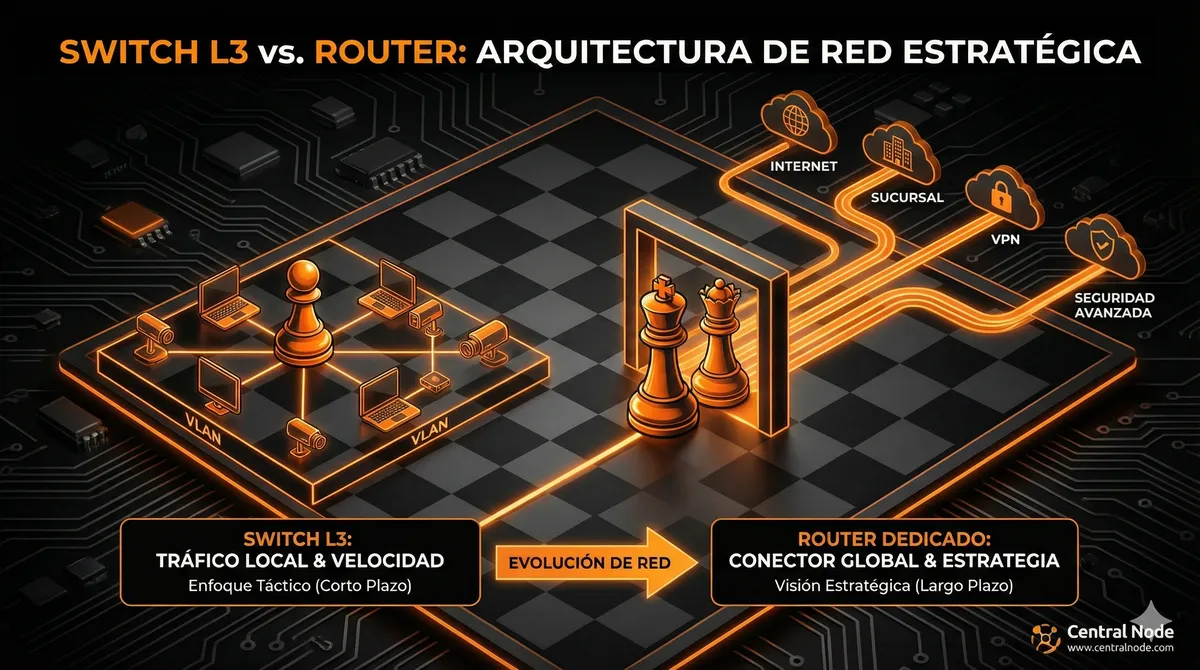
Automated Translation: This article was originally written in Spanish and translated by Gemini AI.
At the heart of every modern business beats its computer network. It is the artery through which vital information flows, and every decision about its architecture can mean the difference between smooth operation and a performance and security nightmare. One of the most recurring and critical dilemmas for network architects is: do we choose a Layer 3 Switch (L3 Switch) or a dedicated Router?
At first glance, the answer seems simple, often dictated by budget or a superficial preference. But let me tell you: opting for an L3 Switch thinking that "it does the same thing but cheaper" is a common trap that can cost much more in the long run.
The L3 Switch vs. Router: A Matter of Purpose, Not Just Price
Understanding the essence of each device is crucial:
- The Switch: Even an L3 Switch, at its core, is a master of local traffic (Layer 2). Its strength is rapid interconnection within the same network, segmentation with VLANs, and optimizing data flow between directly connected devices.
- The Router: It is the connector of worlds (Layer 3). Its true magic lies in its ability to route traffic between different networks (subnets, separate VLANs, the internet) and apply complex security policies. It is the brain that makes decisions about the best path for data to reach its final destination.
Real Case: Security and Scalability at Stake
Imagine a small business with 10 users, all happily connected to a central switch. The operation is simple. One day, the owner decides to add IP cameras to improve surveillance. The quickest solution seems to be connecting them to the same switch.
Problem in sight: Users and cameras sharing the same network? An enormous security risk. Any employee, intentionally or accidentally, could access the cameras or be a point of infection for that sensitive network.
The First Solution: VLANs to the Rescue. The logical answer is segmentation. We implement VLANs (IEEE 802.1Q) to isolate the cameras into their own logical network. Excellent! Security improved.
But a new challenge arises: the owner, from the user network, can now not view the cameras. Communication is needed between the user VLAN and the camera VLAN. This is where the network administrator faces the decision: Router or L3 Switch?
The Strategic Choice: Thinking About Tomorrow
If the only need is communication between those two internal VLANs, an L3 Switch seems like the most economical option. And yes, it can solve that specific problem. However, an L3 Switch is essentially a Layer 2 Switch with limited routing capabilities, designed primarily for internal, low-volume inter-VLAN routing.
Here is the trap: The network always evolves. What happens if tomorrow the owner wants to access the cameras from their mobile phone outside the office? Or if the company opens a branch and needs to securely connect both networks?
The limitations of the L3 Switch will become apparent:
- Heavy Load Performance: Its hardware is not optimized for large volumes of routing between multiple external networks.
- Advanced Security: Lack of critical functions such as stateful firewalls, robust VPNs, advanced content filtering, or intrusion prevention systems (IPS/IDS) that a dedicated router offers.
- Multiple Internet/WAN Connection: They are not designed to handle multiple WAN connections, complex routing policies, or global traffic prioritization.
- Future Scalability: They fall short when network complexity grows beyond internal segmentation.
It is in these scenarios where a dedicated router proves its true worth. Its architecture is designed for resilience, perimeter security, and the flexibility to route complex traffic between diverse networks, including connecting to the Internet and other locations.
Key Message for Network Administrators: Be a Strategist, Not a Patch Fixer
The lesson is clear: designing a network is not just about meeting immediate requirements; it is about thinking big and planning for the future. Network administrators are the true architects of a company's digital infrastructure.
Your responsibility is not just to implement a solution, but to anticipate business evolution. A router might seem like a greater initial investment or more complex to configure, but its versatility, robustness, and advanced security capabilities are the key to facing the challenges that will inevitably arise as the network grows and interconnects with the outside world.
Network infrastructure is a game of chess, not checkers. And you, the network administrators, are the master strategists who must move the pieces thinking several moves ahead to guarantee an efficient, secure, and scalable network!